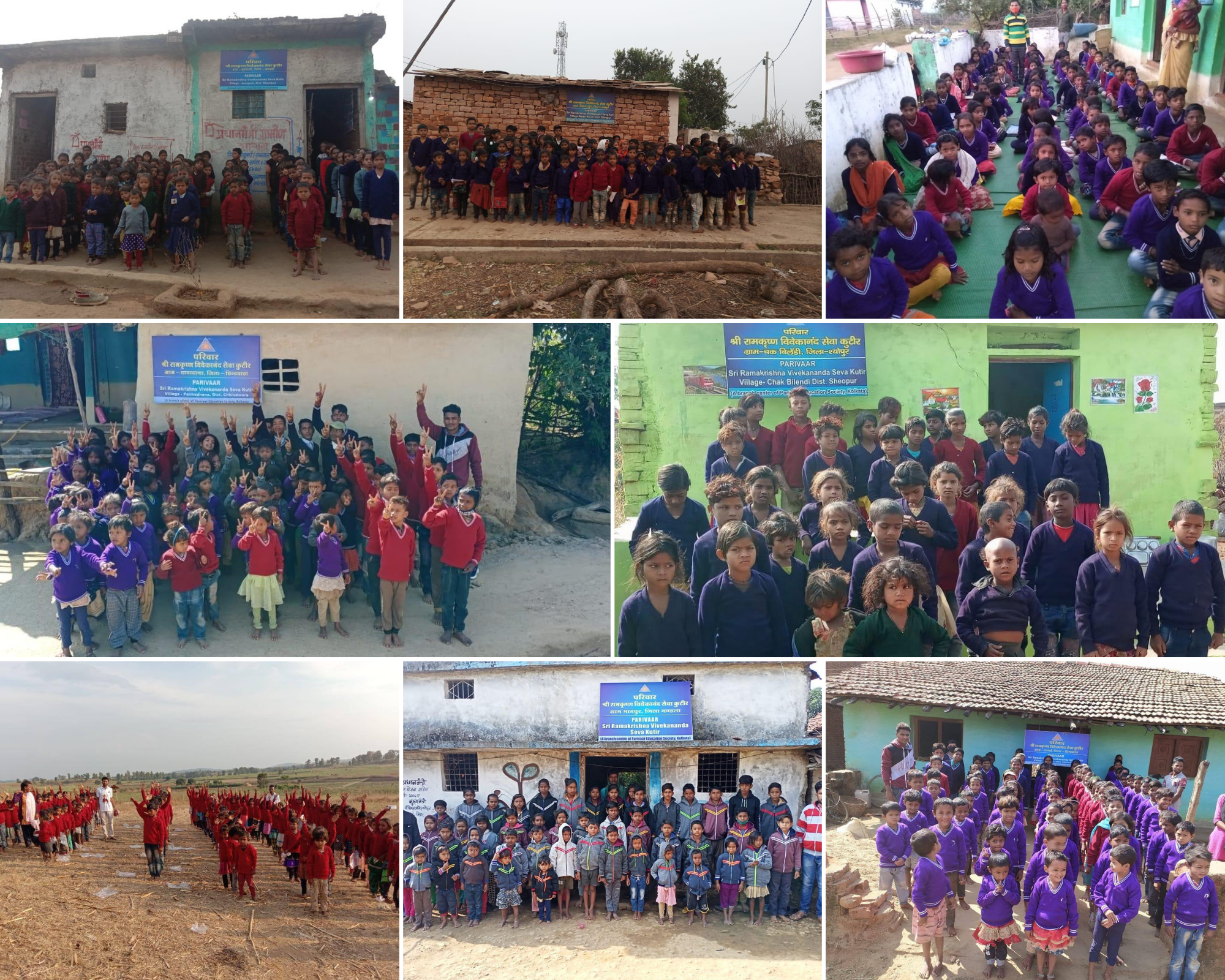
Out of all the tribal areas in 6 districts of MP where we have our Seva Kutirs, Karahal block in Sheopur district has the worst conditions. Out of more than 300 blocks in MP, it is the worst in terms of malnourishment, other health parameters, education and overall development. This abysmal situation of more than 100 villages in Karahal block prompted us to start the Seva Kutirs in July 2019. At present, we have 51 Seva Kutirs in as many villages, and in the next one year, we will be having 100 Seva Kutirs, serving more than 10,000 children.
These villages are inhabited by Sehariya tribals, which are categorized as a PVTG (Particularly Vulnerable Tribal Group). The Sehariyas are among the most deprived and poor communities in the whole country. They severely lag in terms of health, education and income parameters
The Sehariyas are engaged in farm or sometimes non-farm labour work. They were traditionally entirely dependent on forests and also lived quite close to the forests. But for the past several decades, with forests getting depleted, their dependence on forest has hugely reduced.
In a Sehariya household in these villages, there is no concept of breakfast. If anyone – be it a child or an adult – is hungry, then they would eat previous night’s stale rotis with black tea (as milk is not available) or just the rotis itself. Milk and hence milk products like curd, ghee etc are totally unavailable in the Sehariya households. They do not have the capacity to rear cattle because there are no pastoral lands. Grazing is legally prohibited in these areas due to forest laws, though some people stealthily take the cattle into forests in dark hours.
They have meals two times a day, in the afternoon and at night. This meal consists of rotis (of wheat or bajra). Apart from rotis, pulses and vegetables are not available all the time. One thing to note is that meals would consist of only roti with pulses (only rarely with vegetables). Often when even these are not available, they use chutney of chilies or they eat the rotis with onions. As a proxy for proper vegetables, they depend on the forest shrubs and use certain naturally growing plants as vegetables which are generally not used by other communities, such as pamar, sag, sareta, baasi. Even these are available only in the months of the rainy season.
In other seasons, around 60-70 per cent families have no ability to buy vegetables from the local market which is also weekly in nature (the village haat). They would have vegetables in their meals once in a week. Only some of the families get to eat it 2-3 times in a week. So, their staple diet is rotis and pulses. Rice is taken quite infrequently in Sehariya communities. They get wheat at subsidized rates from the government (around 30-35 Kgs for a family) and also some amount of rice, sugar and salt. In their own farms, they would grow bajra or in some cases wheat. Thus, the children severely lack in terms of protein, vitamins and minerals which is indicated in the health parameters.
The Sehariyas marry at an early age. It is not uncommon to find girls and boys married at the age of 14 or 15. We met many such girls and boys. In a large number of villages there is no single graduate ever, and very less number of Higher Secondary pass-outs.
After the opening of Seva Kutirs in these villages, we emphasize in community meetings on not getting children married at such ages, and the whole village should pledge for that. We also ask the villagers to have a goal that all boys and girls should study till Higher Secondary at least, that will open possibilities of government jobs due to benefits of reservation.
Sheopur being a district close to many parts of Rajasthan, the young people between 20 and 40 form a big chunk of migrant labour to those areas of Rajasthan. Sehariyas migrate to towns like Sawai Madhopur, Bundi, Kota, or even Jaipur as migrant labour.There are many months when there is no income at all for those who do not migrate (who are typically in the bracket of 45 plus).
There are only 2 government ambulances in an area which is 4000 sq km. And no other means of public transport. The plight of the people who need emergency medical attention like from an accident, snake-bite can be imagined. Usually ambulance service is sought for birth delivery cases and for that the date is booked well in advance. The elderly are hardly taken for any medical consultation – it is assumed that those in their last leg of life will pass away sooner or later, it is, as it were, accepted naturally by all.
Seeing this dire need we have decided to start ambulance service from Parivaar in this area.
Month: December 2020
Parivaar Seva Kutirs Enter the 6th District (Khandwa)
We have started our first Seva Kutir in Khalwa block of Khandwa district in October 2020. There are 147 villages in this block. This block is infamous for malnourishment and deaths due to malnutrition. It has 75 percent Korku tribal population and remaining are from the Gond tribe. It borders Melghat region of Maharashtra which also is demographically similar and also similarly lagging in health and nutritional indices. The two states are separared by the Tapti river in this region.
We sent a team headed by one of our District Anchors to survey the area, meet village community, Sarpanchs and the government officials. Our team identified and finalized the venues for starting Seva Kutirs, all of which have been given free of cost by the villagers, as they are very keen for having Seva Kutirs in their villages. At present, we have 18 Seva Kutirs and we and we plan to set up at least 50 Seva Kutirs here in the next one year.

Seva Kutirs – Serving children amidst the Pandemic
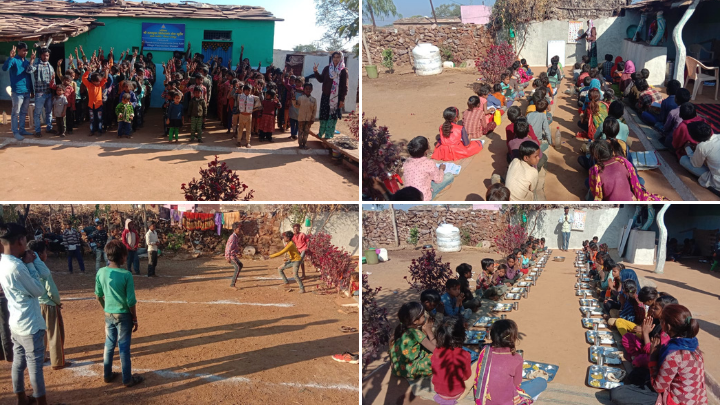

All our Seva Kutirs became functional from the 1st week of June onwards. Initially, our teachers started teaching children in smaller groups in their homes, and from August onwards, regular classes at Kutirs started. We have been taking all safety measures and at the same time providing meals and education to all children in these villages. As government schools are closed during all this time, the education and lunch and dinner provided in the Seva Kutirs is the only meals and education support for these tribal children.


We have also started new Seva Kutirs in some of these districts. By end of November, we have 207 Seva Kutirs, serving more than 20,000 children daily. Since the pandemic, we have started 50 new Seva Kutirs.
Parivaar Winter Relief for Uncared for Elderly
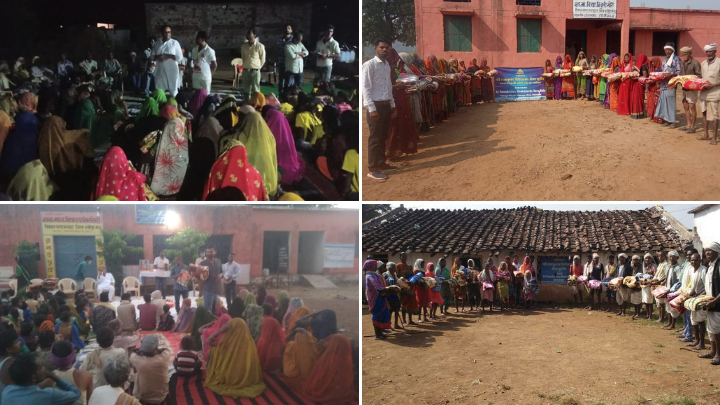
8000 blankets distributed to vulnerable elderly across more than 200 tribal villages in 7 districts of Madhya Pradesh. We completed this big logistical exercise last week. Quality blankets were ordered from Ludhiana in Punjab and ferried to more than 200 villages, many of which did not have any roads. This line of work is seen these days to be old-fashioned charity, even regressive, by most sections of ‘the development sector’, particularly when the beneficiaries are people who have long lost their productive possibilities – the vulnerable elderly or such. But we do undertake such activities annually apart from Parivaar’s regular work of educating feeding and taking care of 20 thousand children on a daily basis. We have found that it is very rejuvenating to our spirit and sharpens empathy of all our workers and volunteers. I increasingly feel that the society which cares for its vulnerable non productive class is most empathetic and is an ideal for society to achieve.
This is a Sample Headline
The human being’s worth cannot be measured in terms of economic possibilities only. I was fortunate to have been present in about 20 such villages during the distribution and interactions with our elderly, hearing their problems and receiving their blessings.