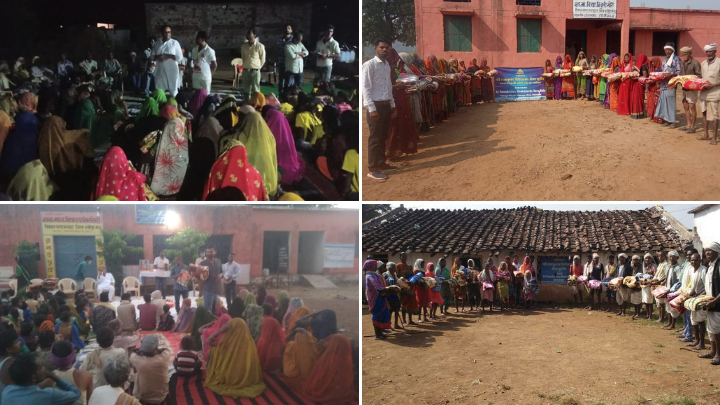
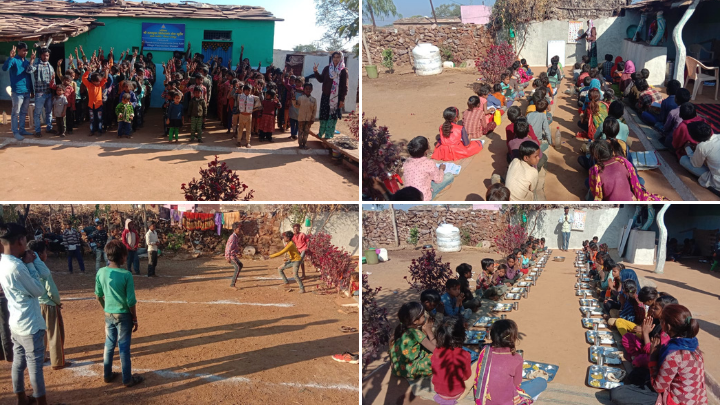
Out of all the tribal areas in 6 districts of MP where we have our Seva Kutirs, Karahal block in Sheopur district has the worst conditions. Out of more than 300 blocks in MP, it is the worst in terms of malnourishment, other health parameters, education and overall development. This abysmal situation of more than 100 villages in Karahal block prompted us to start the Seva Kutirs in July 2019. At present, we have 51 Seva Kutirs in as many villages, and in the next one year, we will be having 100 Seva Kutirs, serving more than 10,000 children.
These villages are inhabited by Sehariya tribals, which are categorized as a PVTG (Particularly Vulnerable Tribal Group). The Sehariyas are among the most deprived and poor communities in the whole country. They severely lag in terms of health, education and income parameters
The Sehariyas are engaged in farm or sometimes non-farm labour work. They were traditionally entirely dependent on forests and also lived quite close to the forests. But for the past several decades, with forests getting depleted, their dependence on forest has hugely reduced.
In a Sehariya household in these villages, there is no concept of breakfast. If anyone – be it a child or an adult – is hungry, then they would eat previous night’s stale rotis with black tea (as milk is not available) or just the rotis itself. Milk and hence milk products like curd, ghee etc are totally unavailable in the Sehariya households. They do not have the capacity to rear cattle because there are no pastoral lands. Grazing is legally prohibited in these areas due to forest laws, though some people stealthily take the cattle into forests in dark hours.
They have meals two times a day, in the afternoon and at night. This meal consists of rotis (of wheat or bajra). Apart from rotis, pulses and vegetables are not available all the time. One thing to note is that meals would consist of only roti with pulses (only rarely with vegetables). Often when even these are not available, they use chutney of chilies or they eat the rotis with onions. As a proxy for proper vegetables, they depend on the forest shrubs and use certain naturally growing plants as vegetables which are generally not used by other communities, such as pamar, sag, sareta, baasi. Even these are available only in the months of the rainy season.
In other seasons, around 60-70 per cent families have no ability to buy vegetables from the local market which is also weekly in nature (the village haat). They would have vegetables in their meals once in a week. Only some of the families get to eat it 2-3 times in a week. So, their staple diet is rotis and pulses. Rice is taken quite infrequently in Sehariya communities. They get wheat at subsidized rates from the government (around 30-35 Kgs for a family) and also some amount of rice, sugar and salt. In their own farms, they would grow bajra or in some cases wheat. Thus, the children severely lack in terms of protein, vitamins and minerals which is indicated in the health parameters.
The Sehariyas marry at an early age. It is not uncommon to find girls and boys married at the age of 14 or 15. We met many such girls and boys. In a large number of villages there is no single graduate ever, and very less number of Higher Secondary pass-outs.
After the opening of Seva Kutirs in these villages, we emphasize in community meetings on not getting children married at such ages, and the whole village should pledge for that. We also ask the villagers to have a goal that all boys and girls should study till Higher Secondary at least, that will open possibilities of government jobs due to benefits of reservation.
Sheopur being a district close to many parts of Rajasthan, the young people between 20 and 40 form a big chunk of migrant labour to those areas of Rajasthan. Sehariyas migrate to towns like Sawai Madhopur, Bundi, Kota, or even Jaipur as migrant labour.There are many months when there is no income at all for those who do not migrate (who are typically in the bracket of 45 plus).
There are only 2 government ambulances in an area which is 4000 sq km. And no other means of public transport. The plight of the people who need emergency medical attention like from an accident, snake-bite can be imagined. Usually ambulance service is sought for birth delivery cases and for that the date is booked well in advance. The elderly are hardly taken for any medical consultation – it is assumed that those in their last leg of life will pass away sooner or later, it is, as it were, accepted naturally by all.
Seeing this dire need we have decided to start ambulance service from Parivaar in this area.